Western Marsh Harrier
Circus aeruginosus
Aves › Accipitriformes › Accipitridae › Circus
Conservation status: least_concern
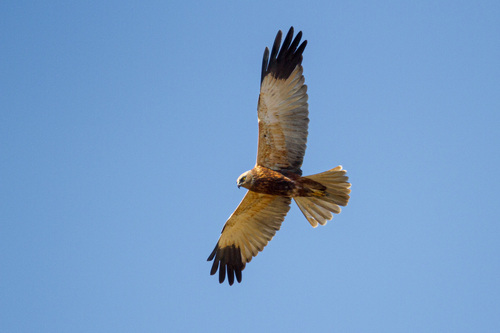
The Western Marsh Harrier is a large, slender raptor that hunts by flying low over wetlands with distinctive paddle-like wingbeats, making it instantly recognizable as it quarters back and forth across reed beds and marshes. Males are grey with black wing tips and a striking pale head, while females and juveniles are dark brown with creamy heads and shoulders, giving them a distinctive two-toned appearance.
How To Identify
It is a relatively large hawk with muted tones of gray and brown plumage. Females are often lighter in coloration than males, and the underparts feature distinctive pale streaks.
Habitat
It typically inhabits extensive reed beds, marshes, and wetland areas with tall vegetation near open water across Europe, Asia, and Africa.
Behaviour
This harrier hunts by flying low and slowly over reed beds, using its long wings and tail to manoeuvre with precision while listening for prey movements in the vegetation.
Native Range
The western marsh harrier is a large harrier, a bird of prey from temperate and subtropical western Eurasia and adjacent Africa. "The western marsh harrier (Circus aeruginosus) is a large harrier, a bird of prey from temperate and subtropical western Eurasia and adjacent Africa.
Did You Know?
Male Western Marsh Harriers are strikingly pale grey while females and juveniles are rich brown, making them appear to be completely different species. This dramatic sexual dimorphism helps them coordinate hunting in pairs over wetlands.
Create a free account to log your sightings of the Western Marsh Harrier, see where it has been recorded near you and build your Wild List.
Privacy · Terms · Impressum · Credits · About the beta