Monk Parakeet
Myiopsitta monachus
Aves › Psittaciformes › Psittacidae › Myiopsitta
Conservation status: least_concern
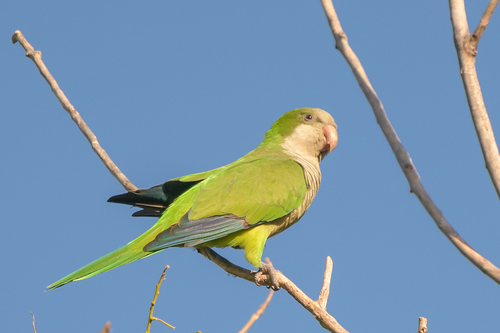
This true parrot is small to medium in size, featuring a bright-green body with a greyish breast and greenish-yellow abdomen. It is primarily herbivorous, though technically omnivorous, eating things such as insects and worms. Feral populations have been recorded in Europe, the Americas, North Africa, the Middle East, and East and Southeast Asia.
How To Identify
A moderately sized, stocky parakeet distinguished by a generally uniform mantle of grey plumage across the body and wings. It possesses bright yellow or orange-ringed bill accents and often shows subtle variations in coloration depending on maturity or subspecies.
Habitat
It typically inhabits open and semi-open woodlands, savannas, grasslands, and cultivated areas across central and southern South America, with introduced populations now established in North America, Europe, and other regions.
Behaviour
They are highly social and vocal birds that live in flocks year-round, communicating constantly with loud, distinctive calls and cooperatively building and maintaining their remarkable communal nests.
Native Range
The monk parakeet originates from the temperate to subtropical areas of South America. "It originates from the temperate to subtropical areas of South America.
Did You Know?
Monk Parakeets are the only parakeet species that build large communal stick nests rather than nesting in tree cavities, creating elaborate apartment-like structures that can house dozens of birds and persist for decades.
Create a free account to log your sightings of the Monk Parakeet, see where it has been recorded near you and build your Wild List.
Privacy · Terms · Impressum · Credits · About the beta