Scarlet Tanager
Piranga olivacea
Aves › Passeriformes › Cardinalidae › Piranga
Conservation status: least_concern
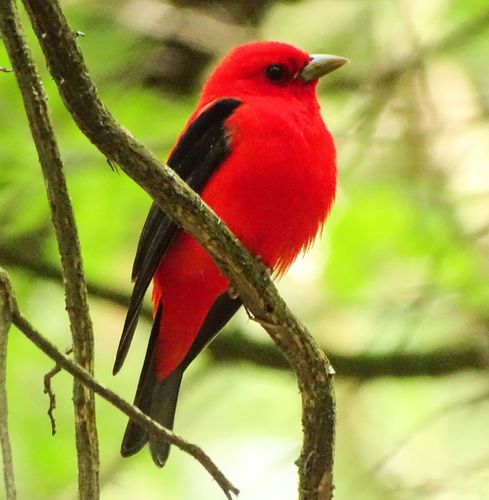
This medium-sized American songbird is a member of the cardinal family. It feeds mainly on insects, but also eats fruit when it is available. It is a passerine bird that can be seen foraging high in trees or on the forest floor.
How To Identify
Males are strikingly vibrant with brilliant scarlet plumage covering their bodies and heads. Females are more muted, featuring olive-green feathers mixed with reddish hues.
Habitat
They breed in deciduous and mixed forests across eastern North America, preferring the canopy of mature trees where they forage and nest.
Behaviour
Males perform a distinctive flutter-flight display during courtship, flying slowly with rapid wingbeats while singing to attract females, and they remain relatively inconspicuous despite their brilliant coloring by staying high in the forest canopy.
Native Range
The scarlet tanager is native to eastern North America and migrates through Central America to spend the winter in forests along the Andean foothills of northwestern South America.
Did You Know?
Male Scarlet Tanagers undergo a dramatic molt each fall, shedding their brilliant red plumage for drab olive-yellow winter feathers—a transformation so complete that early naturalists thought they were entirely different species. They regain their scarlet breeding colors in spring without molting again, an unusual strategy among songbirds.
Create a free account to log your sightings of the Scarlet Tanager, see where it has been recorded near you and build your Wild List.
Privacy · Terms · Impressum · Credits · About the beta