Great Cormorant
Phalacrocorax carbo
Aves › Suliformes › Phalacrocoracidae › Phalacrocorax
Conservation status: least_concern
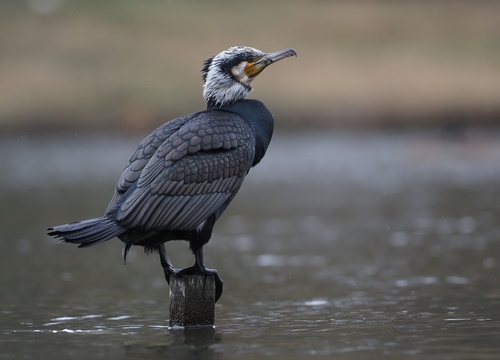
The great cormorant, also known as just cormorant in Britain, as black shag or kawau in New Zealand, formerly also known as the great black cormorant across the Northern Hemisphere, the black cormorant in Australia, and the large cormorant in India, is a widespread member of the cormorant family of seabirds. It breeds in much of the Old World, Australasia, and the Atlantic coast of North America.
How To Identify
It is a large bird with a long neck and powerful legs, characterized by uniformly black plumage and a distinctive yellow bill.
Habitat
Great Cormorants inhabit coastal waters, large lakes, and river systems across the Northern Hemisphere and Africa, favoring areas with abundant fish populations and suitable nesting sites on cliffs, trees, or rocky outcrops.
Behaviour
These birds are highly social, often fishing and roosting in large flocks, and they hunt cooperatively by diving synchronously to herd fish into shallow waters where they are more easily caught.
Native Range
The Great Cormorant is native to Africa, Asia, temperate Asia, tropical Asia-australasia, Australia, and China.
Did You Know?
The genus name is derived from Ancient Greek words meaning "bald" and "raven". A curious hiker might also note that the specific epithet, carbo, is Latin for "charcoal".
Create a free account to log your sightings of the Great Cormorant, see where it has been recorded near you and build your Wild List.
Privacy · Terms · Impressum · Credits · About the beta