Mandarin Duck
Aix galericulata
Aves › Anseriformes › Anatidae › Aix
Conservation status: least_concern
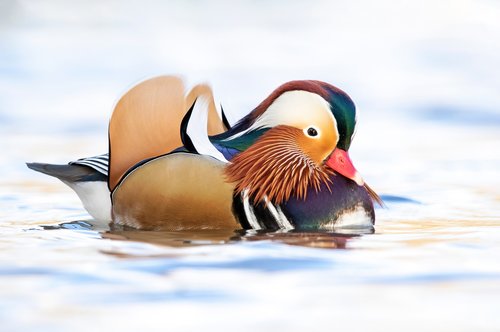
This is a perching duck species that is sexually dimorphic, with males being elaborately coloured and females having more subdued colours. It is a medium-sized duck that feeds mainly on plants and seeds, though its diet changes seasonally. Outside of its native range, the mandarin duck has a large introduced population in the British Isles and Western Europe, with additional smaller introductions in North America.
How To Identify
Males are highly ornamental, featuring vibrant orange chests, glossy green heads, and striking patterns on their tails; females are notably duller brown to provide camouflage.
Habitat
They inhabit forested lakes, ponds, and rivers with dense vegetation and mature trees suitable for nesting in cavities, primarily in temperate and subtropical regions of East Asia.
Behaviour
Unlike most dabbling ducks, Mandarin Ducks perch and nest in tree cavities high above water, and males perform elaborate courtship displays that include exaggerated head movements and wing presentations to impress females.
Native Range
The mandarin duck is native to East and Northeast Asia.
Did You Know?
In Chinese culture, mandarin ducks are regarded as a symbol of conjugal affection and fidelity, and are frequently featured in Chinese art.
Create a free account to log your sightings of the Mandarin Duck, see where it has been recorded near you and build your Wild List.
Privacy · Terms · Credits · Join the beta